You’ve done a lot in school, OJT, or community work — pero wala kang idea how to put it all together.
And now you’re wondering: “Paano ko maipapakita sa employers ‘yung kaya kong gawin kung wala akong formal job experience?”
Nakaka-frustrate, ‘di ba? but don’t worry!
In this episode, you’ll learn 3 simple steps on how to document your skills and experiences into a portfolio that can impress employers — kahit student ka pa:
- Collect Your Work (School, OJT, Community)
- Organize & Describe It (Skills + Achievements)
- Present It Professionally (Printed or Digital)
Table of Contents
Understanding the Importance of a Portfolio
A portfolio is more than a folder of documents — it’s proof of what you can do.
According to LinkedIn, candidates with a skills-based portfolio are 2x more likely to get shortlisted than those with just a resume.
Benefits of having a portfolio:
- Shows your skills visually and concretely
- Helps you stand out kahit wala pang formal work experience
- Gives you confidence during interviews
Step 1 – Collect Your Work
Why It Matters:
You can’t showcase what you haven’t gathered. This is your foundation.
How to Do It:
- From School Projects – reports, presentations, designs, research papers
- From OJT/Internships – documents you created, tools you learned, feedback from supervisors
- From Barangay/Community Work – event photos, certificates, letters of recognition
What It Looks Like in Action:
- A sample PowerPoint from a school presentation
- A project plan you helped create for an NGO
- A customer service feedback note from your internship supervisor
Sample Work/Industry:
- Education – Lesson plans, presentations
- Marketing – Posters, social media content
- Community Development – Event documentation, reports
- Hospitality – Service checklists, guest feedback forms
- IT – Website mockups, coding projects
Did you know: Some recruiters will flip through your portfolio before even reading your resume?
Step 2 – Organize & Describe It
Why It Matters:
A messy portfolio can make you look unprepared. Organizing it shows professionalism.
How to Do It:
- Group items by category (School, OJT, Community)
- Add short descriptions: what the project was, your role, and the skill used
- Highlight achievements: grades, awards, or positive feedback
What It Looks Like in Action:
- “Planned and led a fundraising event, raising ₱10,000 for local school”
- “Created a Facebook content plan that reached 5,000+ people”
Sample Work/Industry:
- Events – Itineraries, budgets, post-event reports
- Design – Canva/Photoshop samples
- Admin – Spreadsheets, schedules, memos
- Sales – Product pitch presentations
- Nonprofit – Volunteer reports, community project summaries
Step 3 – Present It Professionally
Why It Matters:
A good portfolio isn’t just about what’s inside — it’s also about how it looks.
How to Do It:
- Decide format: printed binder or digital PDF/website
- Use clean layouts and consistent fonts/colors
- Include a title page with your name and contact details
- For digital portfolios, use free platforms (Canva, Google Sites)
What It Looks Like in Action:
- A neat printed binder you can bring to interviews
- A PDF with clickable sections
- An online portfolio link in your resume
Sample Work/Industry:
- Corporate Jobs – PDF format for emailing HR
- Creative Fields – Online portfolio with visuals
- Freelance Work – Link to project samples
- Education – Lesson plan binder
- Tech – GitHub or code repository
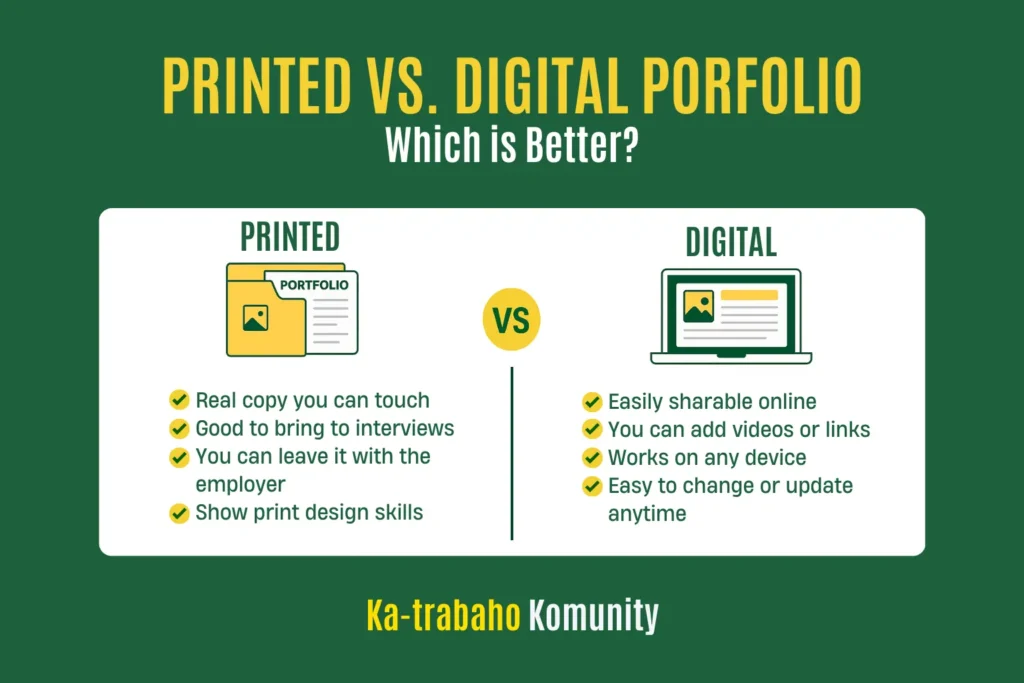
Action Plan for You on How to Document your Skills
Step 1: List down all your past projects from school, OJT, and community work.
Step 2: Pick the best ones and describe them clearly.
Step 3: Arrange them in a printed or digital format.
Download: Beginner’s Portfolio Template for Students
Simulan mo na ang paggawa ng first professional portfolio mo — download the Beginner’s Portfolio Template for Students ngayon!
Conclusion
A document of your skills is more than just a collection of papers or pictures — it’s your personal highlight reel. It’s living proof of what you can do, even if you haven’t been officially hired yet.
Kahit school projects, OJT outputs, or barangay/community work lang ‘yan, if you know how to present them well, they can speak louder than a resume alone.
Trust us, we’ve been on both sides of the table — as job seekers and as recruiters — and we’ve seen how portfolios can make a candidate stand out instantly.
So don’t wait for your “first real job” before you start. Begin documenting your skills now, because every project, every skill, and every effort you’ve made can be the key that opens the door to your future career.
Join Us. Grow With Us. Ka-Komunidad Mo Kami.
✅ Subscribe to our Newsletter
Stay updated with new job tips, free templates, kwentos from real KaTrabahos, and upcoming events.
No noise. Just real help.
✅ Join Our Facebook Group
Real-time conversations, questions, kwentuhan, and job alerts — kasama ang buong Komunidad.
✅ Submit Your Story or Tip
Your voice might be the sign someone else is waiting for. Share your experience — it matters.
Leave a Reply